REYES PATIENT EDUCATION · 001
How dental
implants work.
A dental implant can replace the root of a missing tooth and support a restoration above it. Explore the components, planning, placement, healing, and restoration one step at a time.
Educational information · Not patient-specific
Explore the story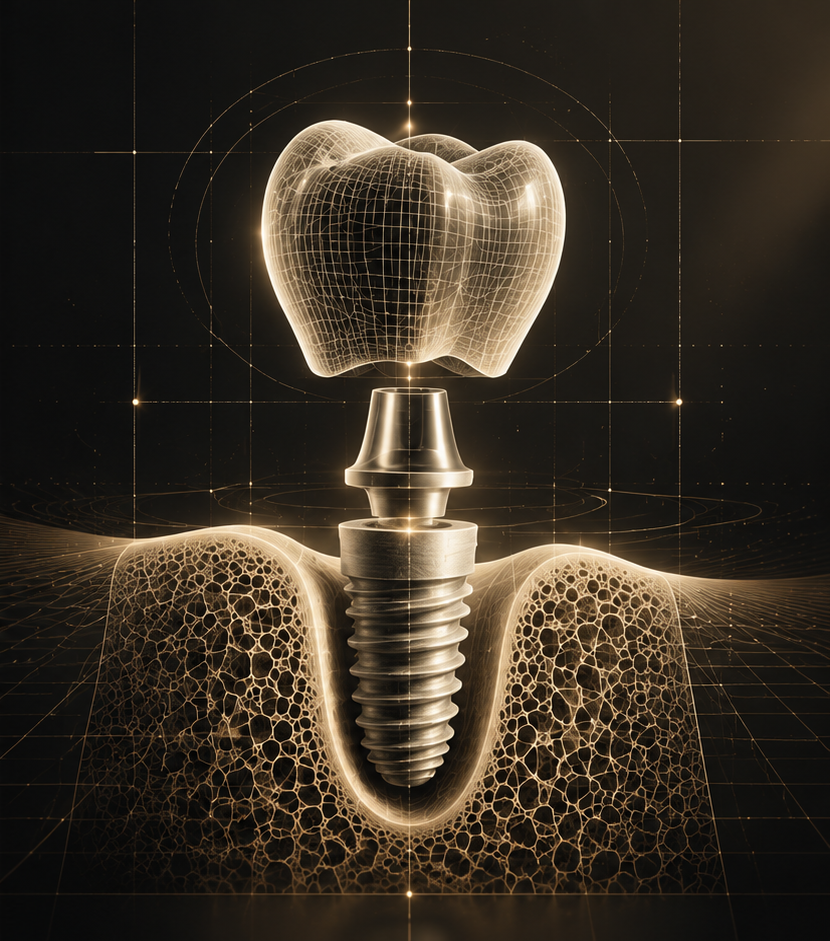 ANATOMY, UNDERSTOOD.
Explore at your own pace. These illustrations explain relationships—not your anatomy or a fixed treatment sequence.
01 / THE COMPONENTS
More than just a tooth.
A restoration above. A foundation below.
The crown replaces the visible part of the tooth. The abutment connects the restoration to the implant. The implant is placed within supporting bone.
This single-tooth example explains how parts connect. Implant restorations do not all use identical components or designs.
Crown · The restoration replacing the visible portion of the tooth.
EDUCATIONAL SCHEMATIC · NOT TO SCALE
02 / PLANNING
Treatment begins before the implant is placed.
The restoration helps guide the plan.
The dentist evaluates the proposed restoration, available bone, surrounding anatomy, oral health, and individual circumstances.
Examination and appropriate imaging inform an individualized plan. Digital planning supports clinical judgment; it does not guarantee the surgical or restorative result.
Examination · Understanding oral health, the missing-tooth site, and treatment goals.
EDUCATIONAL SCHEMATIC · NOT TO SCALE
03 / BONE
The foundation matters.
Different sites need different plans.
Adequate supporting bone is important for placing an implant. In some situations, additional bone augmentation may be considered.
Bone grafting is sometimes recommended before or at implant placement, depending on anatomy and the treatment plan. Not every patient needs grafting. These diagrams cannot determine candidacy.
Supporting bone
Augmentation may be considered
CONCEPTUAL COMPARISON · NOT A CANDIDACY ASSESSMENT
04 / PLACEMENT
Placing the implant.
A carefully considered position.
The implant is surgically placed into bone at the planned site. The exact technique varies according to the clinical situation.
A non-graphic schematic of positioning, not a surgical guide. The procedure, approach, and sequence are individualized.
EDUCATIONAL SCHEMATIC · NOT TO SCALE
05 / HEALING
Then biology takes over.
A living foundation.
The surrounding bone heals around and establishes contact with the implant surface, helping create a stable foundation for the restoration. This process is called osseointegration.
Healing and restoration timing vary according to the site, bone, procedure, health factors, stability, and treatment plan. This progression shows a concept, not a timescale or promised result.
EDUCATIONAL SCHEMATIC · NOT TO SCALE
06 / RESTORATION
Completing the tooth.
The connection becomes a restoration.
An abutment can connect the implant to a crown. The restoration is designed to restore function and appearance; the exact restorative approach depends on the individual case.
The timing, materials, attachment, and restoration design are part of the individualized treatment plan.
EDUCATIONAL SCHEMATIC · NOT TO SCALE
07 / MAINTENANCE
Implants still need care.
Ongoing care is part of the story.
Daily oral hygiene remains important. The tissues around implants need to remain healthy, and professional examinations and maintenance remain important.
Implant restorations and their components can require maintenance over time. They are not lifetime or maintenance-free replacements.
Daily hygiene · Follow the cleaning instructions provided by your dental team.
EDUCATIONAL SCHEMATIC · NOT TO SCALE
Continue learning → Why Bone Matters
A LITTLE MORE CLARITY
Common questions.
Does implant placement hurt?
Local anesthesia is commonly used during placement. Postoperative discomfort and recovery experiences vary; your dental team will explain the care plan and what to expect.
How long does the process take?
Timing varies substantially with the site, healing, grafting, treatment sequence, and individual circumstances. There is no single timeline that applies to everyone.
Do I need a bone graft?
That can only be determined after clinical and radiographic evaluation. Some sites require additional bone support; others do not.
Can everyone get implants?
Candidacy depends on an individualized evaluation of oral and overall health, anatomy, and treatment goals.
How long do implants last?
Longevity varies with biological, mechanical, hygiene, health, and maintenance factors. Implants and restorations can develop problems and may need treatment or replacement.
What are alternatives to an implant?
Depending on the situation, alternatives may include a fixed bridge, removable prosthesis, maintaining the space, or other individualized approaches. Your dentist can discuss their benefits and limitations.
A CONVERSATION IS A GOOD START
Wondering whether an implant
is an option for you?
An examination gives us a starting point to discuss your options.
An appointment request does not confirm an appointment.